
This post contains affiliate links. Please see our disclosure policy.
Ye’difin Misser Alicha – Lentils in Garlic-Ginger Sauce. Easy Ethiopian Lentils. Vegan Gluten-free Soy-free Recipe
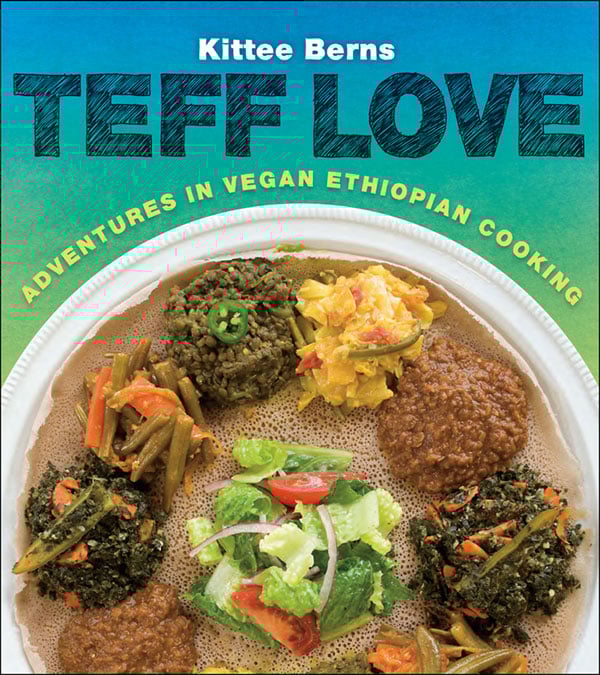
Teff Love: Adventures in Vegan Ethiopian Cooking
And this book demystifies all that. From the basics about the spices, making your own berbere and seasoned oil to many authentic and fusion dishes. The seasoned oil is highly addictive. It’s amazing how a few spices that I use quite often, in a combination that I have not used before (nigella and carom seeds!), in a method I have not used often (slow simmered instead of the usual high heat tempering in Indian food), lead to a deep complex flavor.
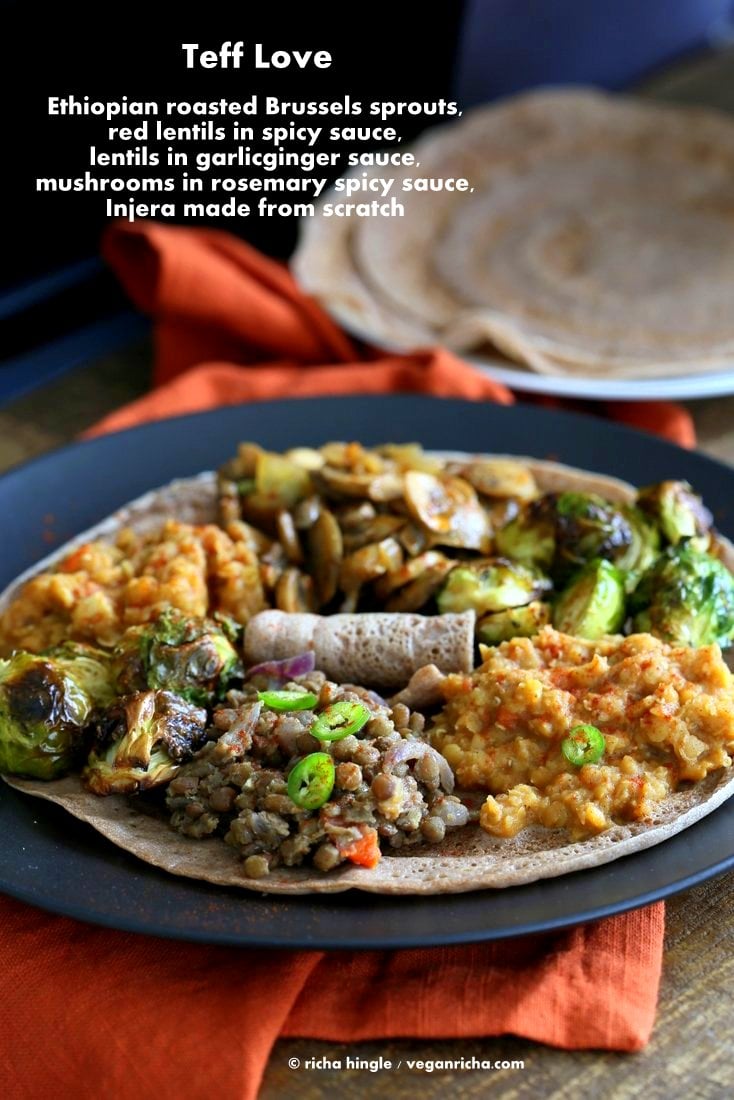
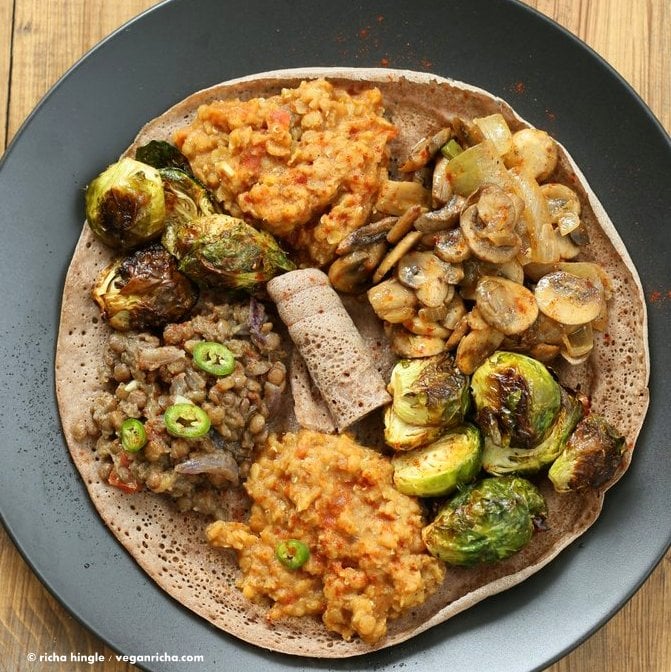
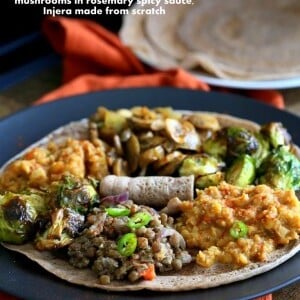
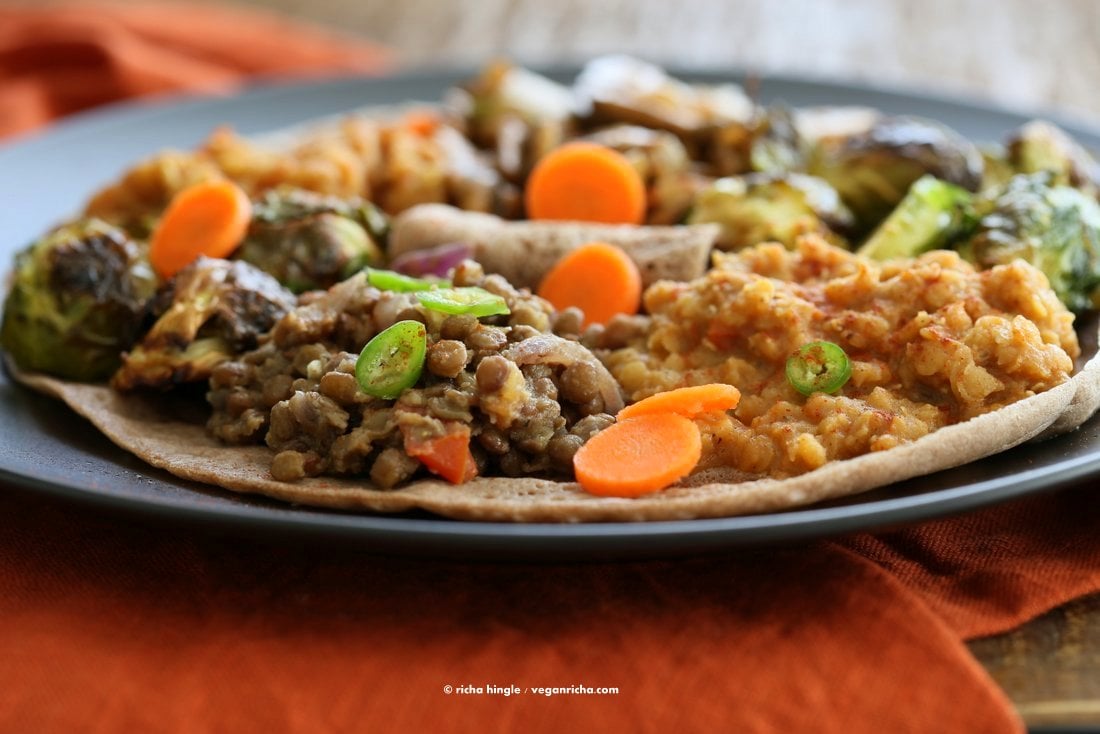
I made the berbere paste and seasoned oil and the planned out the menu for the next day! Mushrooms in rosemary onion wine sauce, Red lentils in spicy sauce, Ethiopian roasted Brussels sprouts and Brown lentils in flavorful garlic-ginger sauce and freshly made Injera!
That was one feast! I have many recipes that I have book marked to try like the Awaze tofu, azifa salad, butecha, tofu dumplings. many more lentil and split pea dishes and the teff brownies!
Ethnic food makes eating lentil and vegetable heavy vegan food easier. Or so I think because you know I love Indian food for the same reason. It is flavorful. It is easy or gets easy with just a little initial pantry and time investment. It is generally flexible to play around with once you get a hang of it. The spices are generally shared over other cuisines like Indian and Mediterranean. I did not have to go to any special store for the book. I already have an extensive Indian pantry :). I also had teff from my gf baking experiments.
Get your copy of Teff Love
I have been putting the seasoned oil in our Tofu scrambles and simple weekday dals! It is just so fabulous. Chapters include tips, equipment, Grocery list (which is great to quickly stock your pantry), Foundations, Breakfast, Appetizers, Spicy sauces, mild sauces, legume based smooth sauces, cooked and cold vegetables, injera based dishes, Stir fries, Dumplings and veggie protein, Beverages and Sweets.
If you are sensitive to spices or food that has many spices and oil, use the seasoned oil within a week.
If you haven’t tried Ethiopian before, serve it differently. Serve the drier lentils with roasted veggies and cooked grains, serve the saucy lentils as a soup with crackers or croutons.
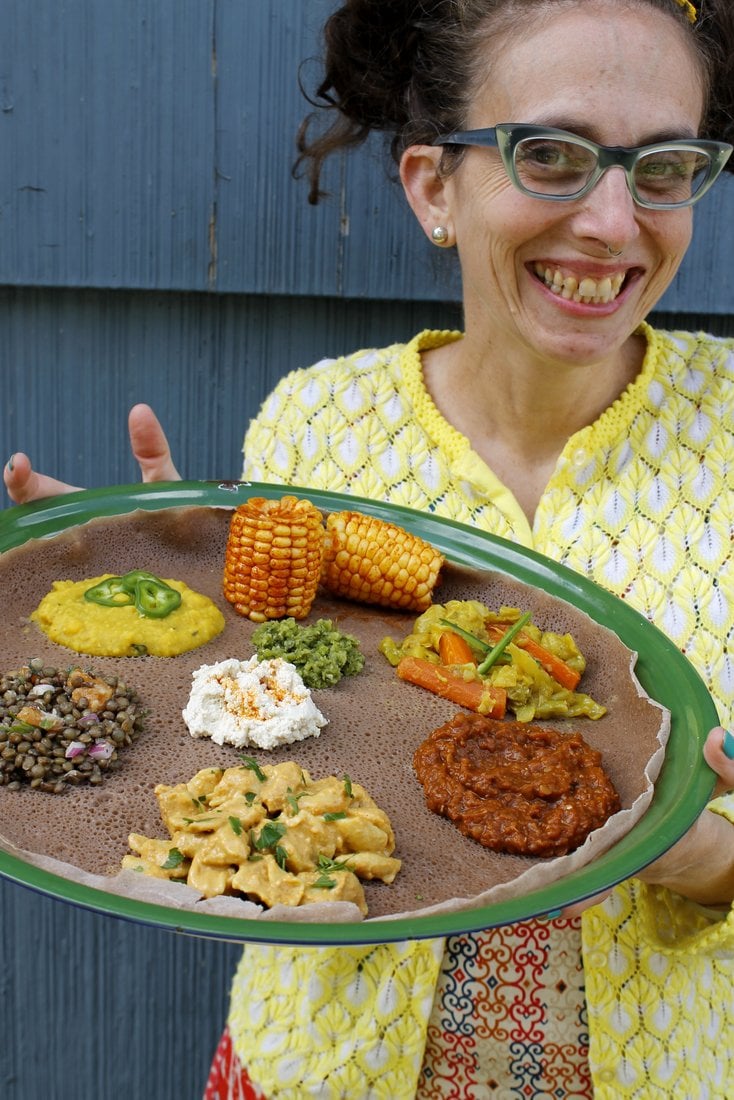
Kittee with some fabulous food!
I also made the Injera from scratch from the book. The whole ersho sourdough and the days and days of fermentation. Towards the end, I added a bit of regular white flour instead of all teff for the last day of fermentation and got the beautifully porous Injera. Soft, delicious and perfect.
Thankfully I can get as much Injera as I want. I’ve got a couple of Ethiopian restaurants within a 10 block radius!
Injera! See them exclamations, Clearly very excited. I used my Dosa crepe pan to make them and it worked out perfectly.
Perfect carrier for all that Ethiopian food. It takes some patience to make Ethiopian, but it is all worth the effort. I share the recipe of lentils with flavorful garlic ginger sauce Ye’difin Misser Alicha today!
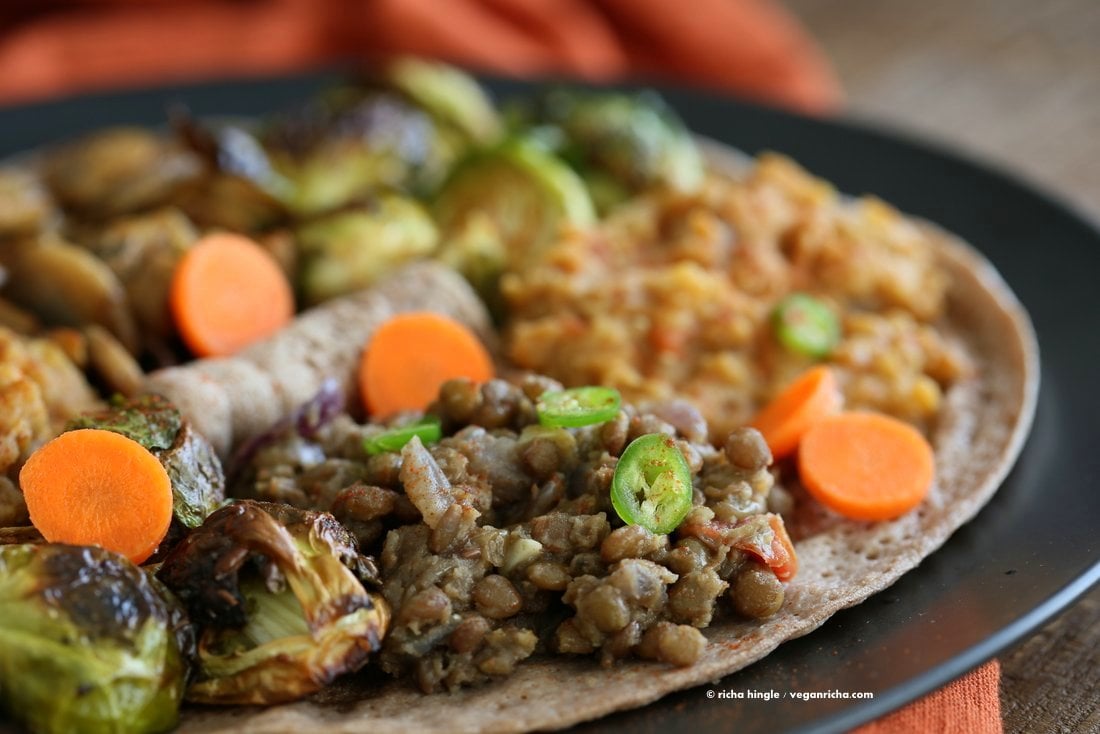
Ye’difin Misser Alicha
from the book Teff Love: Adventures in Vegan Ethiopian Cooking by Kittee Berns (printed with permission from the Book Publishing Co.)
Ye'difin Misser Alicha - Lentils in Garlic-Ginger Sauce Recipe.
Ingredients
- 1 cup dried green or brown lentils
- 6 cups water
- ¼ onion, minced (½ cup)
- 3 tablespoons Ye’qimem Zeyet, page 25 or extra-virgin olive oil
- ½ teaspoon salt, plus more if desired
- 6 cloves garlic, pressed or grated (1 tablespoon)
- 2 teaspoons peeled and grated fresh ginger
- 6 fresh basil leaves, optional
- ½ teaspoon ground turmeric
- 1½ cups reserved lentil cooking water or Sleepy Vegetable Stock, page 38, plus more if desired
- 1 to 2 jalapeno chiles, seeded, veined, and sliced into thin half-moons
Instructions
- Put the lentils and water in a large saucepan and bring to a boil over high heat. Stir to keep the lentils from sticking to the bottom of the pot. Decrease the heat to medium-high and simmer, skimming off and discarding any foam that forms with a large spoon. Cook uncovered, stirring occasionally, until the lentils are tender but still firm, 10 to 12 minutes. Drain the lentils and reserve 2 cups of the cooking water.
- While the lentils cook, put the onion, Ye’qimem Zeyet, and salt in a large saucepan and cook over medium heat, stirring frequently, until soft and translucent (don’t let the onion brown), about 7 minutes. Add the garlic, ginger, optional basil, and turmeric and cook, stirring almost constantly, for 3 minutes.
- Stir in the drained lentils and 1 ½ cups of the reserved cooking water. Increase the heat to high and bring to a boil. Decrease the heat to medium and simmer uncovered, stirring frequently, until the lentils are very soft but not mushy and the liquid has reduced and thickened, 10 to 15 minutes. Add the jalapeno chiles during the last 5 minutes of cooking. If the mixture is too thick, add up to ½ cup additional lentil cooking water as needed to thin. Season to taste with additional salt if desired. Discard the basil before serving.
Notes
Nutrition
Nutrition information is automatically calculated, so should only be used as an approximation.
The Publishers are giving away a copy of Teff Love to one of the blog readers! (within US). Ends 21st March.
To Enter, please leave me a comment about what do you find most intimidating about ethnic cuisines like Ethiopian.
The giveaway is over. Denise, you get a copy of Teff Love!







I find just being able to always get the ingredients I need to make ethnic dishes. I feel mostly confident if I have the correct ingredients that I can combine them to get the flavor I’m looking for.
I find getting every last ingredient and cooking tool to be the most intimidating. However, I think I have accumulated all the right legumes and spices — just have to get the teff flour and crepe pan if I want to make the injera! We do not have Ethiopian food in my Midwest area but I love it just as much as I love Indian food so it seems I must learn to make it myself! Just got back from Louisville, which has an all-you-can-eat Ethiopian lunch buffet. I only got to go once as it was a bit far from my hotel, but I would have eaten every meal there if I could have!
I think getting the combo of spices correct for authentic taste is the most intimidating.
Trying to make the Ethiopian flavors come alive without using oil will be the biggest test for me. LOVE Ethiopian food and have no qualms about diving in to make the best plant based foods from this oft neglected cuisine .
My mouth is watering yummy!
This cookbook looks so amazing!
The only thing I generally find intimidating about making ethnic cuisines is the difficulty is getting all the necessary ingredients. I currently live in a pretty blah town, and there are so many ingredients – even not very exotic ones – that I have to either buy online or go without. On the bright side, I’m building up an arsenal of decent ingredient substitutions!
What I find most intimidating is learning how to put the seasonings together, and hoping that it comes out in a way that I’ll like and not too spicy. I don’t think I’ve ever tried Ethiopian food, but it’s always nice to have a wide variety of flavors in my repertoire so I don’t get into a food rut.
The most intimidating thing about cooking ethnic cuisines has to be finding the ingredients. So many wonderful spices, vegetables, etc. are not readily available at big box grocery stores and it can be difficult to find smaller ones that have everything I need (especially since I don’t have a car!). If there’s no practical way for me to find something then I’ll try to substitute, but it’s so much better when I am able to find everything and make it correctly!
Making injera from scratch. Was able to find teff flour, but not sure I can do this, even though I am a good cook. But now I am determined! I am going to do this. What’s the worst that could happen? I’d still have the Ethiopian main dish, would just have to serve it with quinoa instead of injera.
Must. Get. Over. Fear to live life fully and have fun and be adventurous cooking!
I don’t find it intimidating at all. I love Ethiopian food and would love to try out the recipes in this book!